
Production stability,
on autopilot.
A team of specialized SRE agents that triage alerts, investigate incidents, and suggest fixes. All before your team opens Slack.
Connects to your existing stack.
Inside the Logsmith.ai Platform
On-call is broken. The cost is measured in hours.
Alert fires. Engineers get paged. Context switches happen. Someone opens a war room, someone starts reading logs. Forty minutes later you have a theory. Two hours later you have a fix. It doesn't have to work this way.
Too much noise, not enough signal
Alert fatigue is real. Engineers tune out pages because most resolve on their own, but the ones that don't cause real damage.
War rooms that shouldn't exist
Three engineers in a Slack thread, one reading logs, one checking dashboards, one guessing. The pattern is the same every time.
Runbooks nobody runs under pressure
Every team has them. Nobody follows them when it counts. The playbook is there. What's missing is something that executes it.
Context that disappears after the incident
Post-mortems get written. The same pattern fires six weeks later. Institutional knowledge lives in people, not systems.
Junior engineers left holding the pager
On-call knowledge is tribal. A new engineer on rotation doesn't have the context a senior does. At 2am, that gap is expensive.
Every incident starts from zero
No memory of what happened last time. No pattern matching across incidents. Each one is investigated as if it's the first.
Delegate production ops to a team of SRE agents.
Each agent owns a specific surface. They share context with each other. When something breaks, they mobilize in parallel, the way a strong SRE team would, without the war room.
Alert triage & on-call
Every alert investigated before a human is paged. Agents correlate signals, assess blast radius, and escalate only what needs eyes on it.
Log analysis & anomaly detection
Continuously reads across logs and traces. Surfaces p99 spikes, rollback ratio drift, and error rate trends before they become incidents.
Incident response & RCA
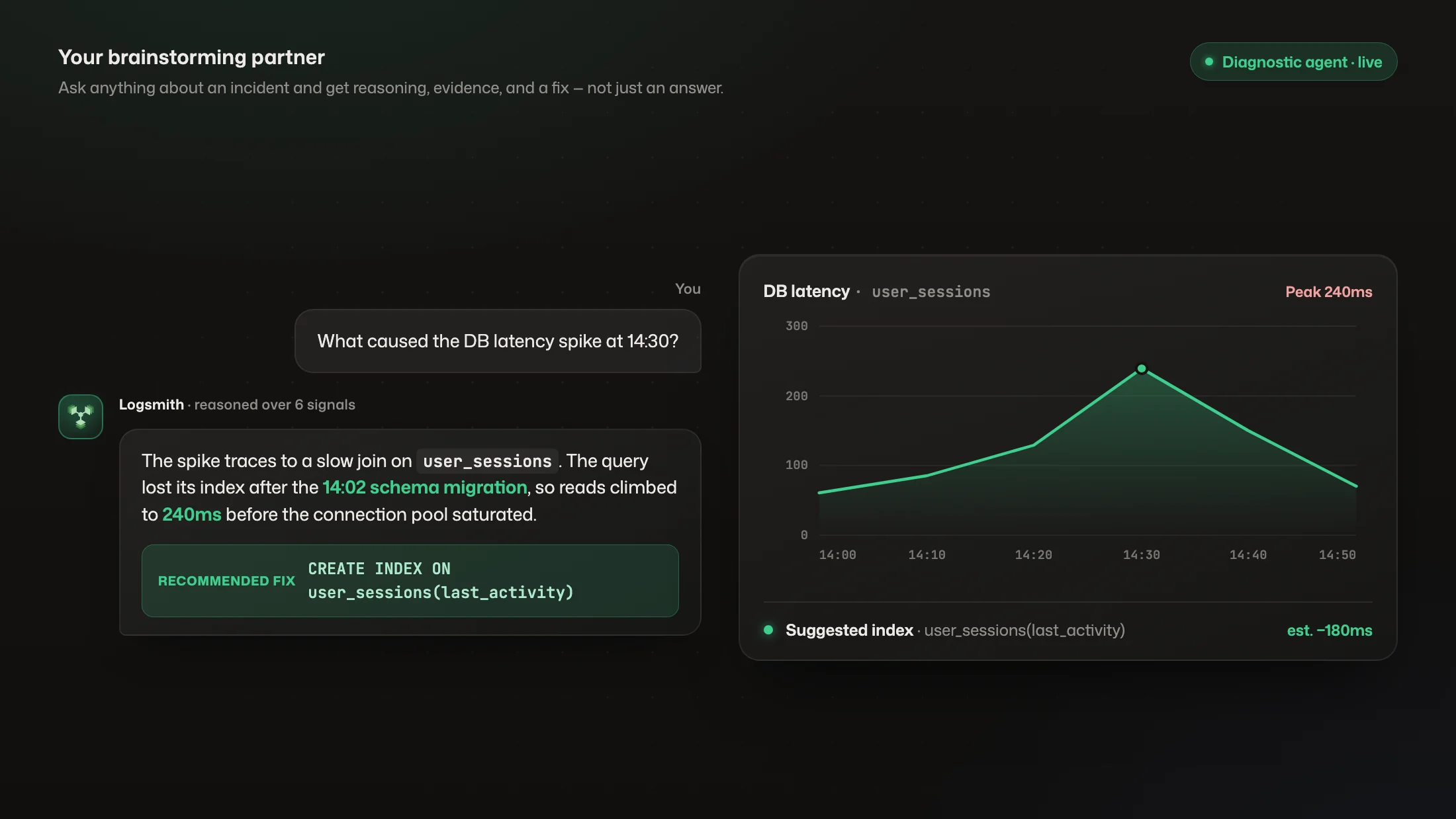
Specialized agents investigate in parallel. Every root cause surfaces with a causal chain and production evidence, not a guess.
Runbook automation
Your operational playbooks become executable workflows. Routine tasks run on schedule or trigger, without anyone having to remember.
Drift control Coming soon
Proactively detects configuration drift before it reaches production and surfaces a fix before the next deploy ships.
What changes when agents run the incident.
Built to run at your pace.
Most production tooling assumes you have time to configure it. Logsmith assumes you don't.
Connected in hours, not months
Plug into Datadog, Grafana, GitHub, Slack. Logsmith starts reading signals immediately. No multi-month onboarding, no services contract.
Agents that coordinate, not just respond
A triage agent, an investigator, a verifier: each specialized, all sharing context in real time. Not a single chatbot guessing in isolation.
Works alongside your SRE function
Logsmith handles the routine, accelerates the critical, and gives your engineers hours back in the day, whether your team is two people or twenty.
Evidence-backed findings, every time
Every root cause comes with a causal chain and production evidence attached. Your team reviews and acts. No black-box conclusions.
Plugs into the stack you already run.
Logsmith connects to your existing observability, alerting, and SCM tooling on day one.